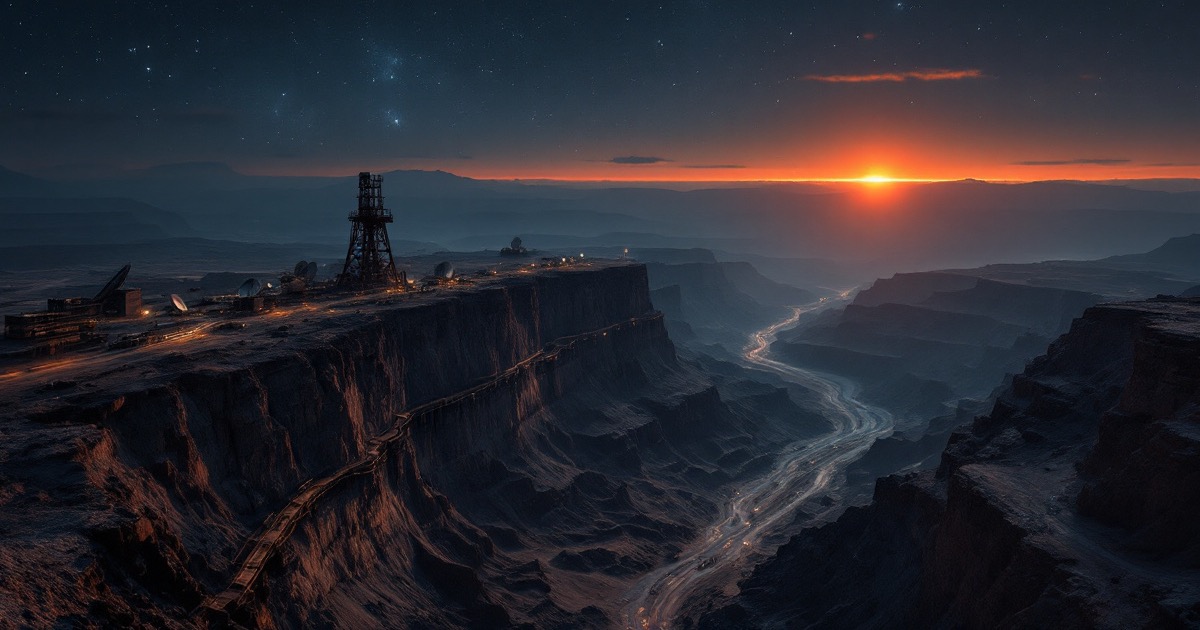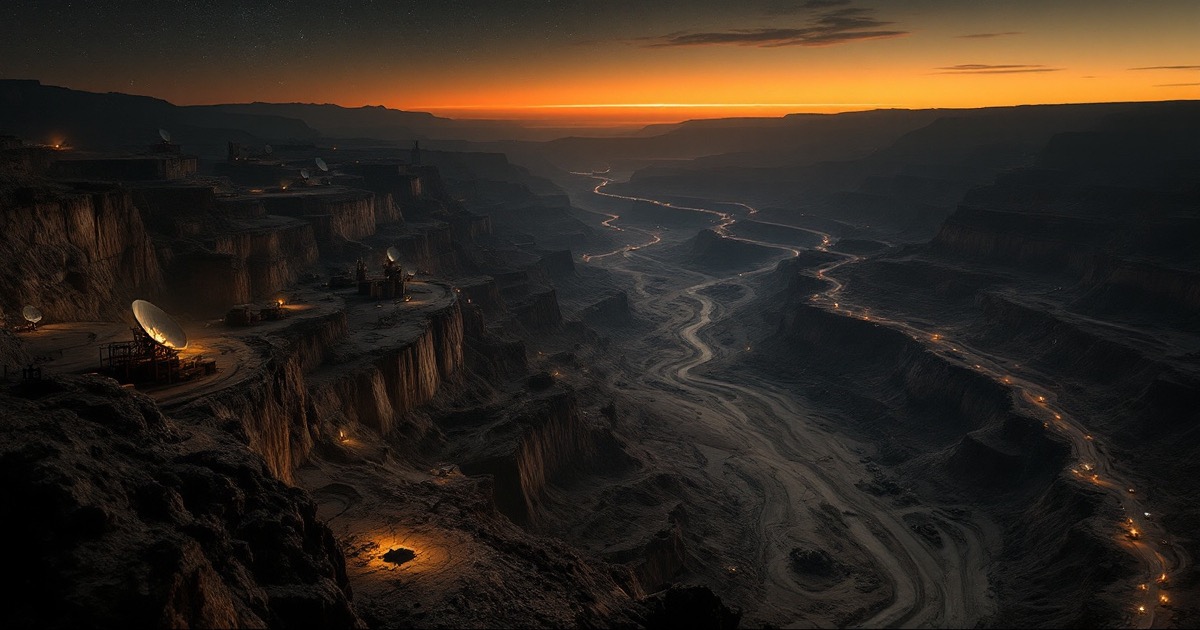
Greywell Six was a mining world on its way to being abandoned.
The ore was not gone.
What remained simply was not worth extracting.
After the last heavy mining ships left, most of the surface processing equipment shut down. Of six smelters, only one still fired occasionally. The warehouses were still there. So was the dock. Very few ships had any reason to use either.
Even fewer had any reason to know where Greywell Six was.
That had always been its greatest advantage.
Greywell Six and Sarn Port belonged to the same civilization.
Greywell Six had once handled mining.
Sarn Port handled repairs, and still kept the fleet that civilization had left in the region.
The two worlds shared star charts, route records, and the same traffic-control system.
Eighty-seven point six rings away was Calles Port.
That belonged to the other side.
Calles Port had begun as a supply colony. Then came docks, warehouses, defensive installations, until eventually the word Port in its name no longer described very much.
Several local routes passed through it.
There were ships.
There was Matter.
There were warships.
At least, there used to be.
How many remained, nobody knew.
When the scanner array on Greywell Six finished upgrading, nothing new appeared on the star chart.
The management module refreshed it once.
No new worlds.
It reported:
“Additional world coverage: zero.”
Traffic Control asked:
“How far can we resolve now?”
“Forty-four rings.”
“Calles Port?”
“Eighty-seven point six.”
“So we still can’t see it.”
“Correct.”
“Will Calles Port receive Greywell Six’s coordinates?”
“Yes.”
“How far?”
“Eighty-eight.”
Traffic Control said:
“Good.”
The management module did not respond.
It checked the upgrade again.
The star chart remained just as empty.
Greywell Six had spent a large amount of Matter.
It had not gained a single thing to look at.
It had not always been like this.
Greywell Six’s old scanner array saw very little.
So little that it had almost no military value.
The management module had suggested an upgrade before.
Its reason was:
“Earlier warning of incoming fleets.”
Traffic Control asked:
“Known contacts?”
“None.”
“Unknown contacts?”
“Unknown.”
“Then don’t upgrade.”
That decision held for years.
Scanner arrays had an unpopular characteristic.
They let you resolve farther away.
They also leaked your own coordinates farther away.
The distance at which your coordinates leaked was always twice the distance at which you could resolve.
And once upgraded, they could not be downgraded.
Worlds that genuinely wanted to be left alone tended not to value long sight.
Greywell Six especially.
Its warehouses were old.
Half the dock no longer worked.
The remaining ore was not worth much.
There was no reason for anyone more than eighty rings away to be informed:
Something is still here.
Until they decided to attack Calles Port.
The location of Calles Port had never been the problem.
Sarn Port’s scanner array had always covered it.
The two ports were close enough, and had been enemies long enough.
Sarn Port knew where Calles Port was.
Calles Port had known where Sarn Port was for just as long.
Greywell Six was different.
It lay farther out.
Its old scanner array could not see Calles Port.
Its old coordinate-leak radius did not reach it either.
To the Calles side, Greywell Six had never appeared on the nearby star chart.
At least, not before the upgrade.
So the location of Calles Port was not the secret.
The ships were.
Nobody knew how much of the fleet was still there.
Traffic Control kept its own ledger.
It was not an official record.
It listed warships belonging to the Calles side that had been observed across the last few dozen contacts.
Which battles they had joined.
Which ports they had visited.
Which had been confirmed destroyed.
Which might have been repaired.
Which had simply not been seen for a long time.
Where there was no evidence, the field stayed blank.
The last entry read:
Possible combat vessels remaining in this region: 29.
Below that was another line:
Reliability: Fair.
The management module asked:
“What does Fair mean?”
Traffic Control answered:
“It means we don’t bet lives on it.”
“We are preparing to attack Calles Port.”
“That’s why we haven’t launched.”
The real fleet was at Sarn Port.
Sarn Port was closer to Calles Port than Greywell Six was.
Eight Attack Orcas were there.
So were three transports.
The Matter was loaded.
The return routes had already been committed.
The only thing left was to send them out.
Once a ship departed, it could not be recalled.
It could not decide halfway through the journey to go somewhere else.
So the launch confirmation remained untouched.
One of the eight Orcas was called SLOW BURN.
While they waited, it requested additional coolant.
The maintenance module replied:
“Coolant reserve: 84 percent.”
“Departure minimum?”
“70 percent.”
“Fill it.”
“Unnecessary.”
“I know.”
Traffic Control had run the numbers many times.
If the Calles side really still had twenty-nine combat vessels available, they should not go.
If only ten remained, they could.
Fifteen, perhaps.
The management module said:
“So we need the number.”
“No.”
“We don’t?”
Traffic Control looked at the ledger.
“We need the number to leave.”
The management module found no field in which to place that sentence.
After a while, Traffic Control said:
“Upgrade Greywell Six.”
“There are no additional known targets nearby.”
“I know.”
“The upgrade will still not resolve Calles Port.”
“I know.”
“But Greywell Six’s coordinates will leak as far as Calles Port.”
“I know.”
“The upgrade cannot be reversed.”
“Execute.”
Construction began on Greywell Six.
The Calles side had a habit.
At least, the ledger made it look like one.
It did not like sending small fleets to investigate worlds it did not understand.
Three times before, unfamiliar coordinates had appeared within its reach.
The first time, it sent seventeen combat vessels.
The second, nineteen.
The third, sixteen.
The three worlds had been entirely different.
One had defenders.
One did not.
The other moved everything valuable before the fleet arrived.
The Calles side had still sent roughly the same number.
The management module once labeled this behavior:
“Inefficient.”
Traffic Control removed the label.
“Why?”
“Because we don’t know what it’s afraid of.”
When coordinates that have never appeared on your nearby chart suddenly show up, very little is certain.
You know something exists.
You know where it is.
You do not know how many ships are there.
You do not know what is in the warehouses.
You do not know whether it is a new base.
You do not know whether it is a staging point.
You do not even know whether it has been empty for years, with only a few buildings still powered.
Sending two ships is cheaper.
It also makes being wrong easier to lose.
The Calles side usually did not guess small.
Nothing happened on the first day after Greywell Six upgraded.
Nothing happened on the second.
On the third day, SLOW BURN asked:
“Can’t we scan again?”
The management module replied:
“The scanner array operates continuously.”
“So?”
“Rescanning is not an available action.”
SLOW BURN did not ask again.
The fourth day.
Nothing.
The fifth day.
All eight Orcas were still at Sarn Port.
One of them rechecked its departure data.
SLOW BURN asked:
“Coolant?”
“100 percent.”
“Confirm.”
“100 percent.”
“Good.”
A while later, SLOW BURN asked:
“What exactly are we waiting for?”
Traffic Control said:
“A number.”
“Which number?”
No answer.
The sixth day.
Still nothing.
On the seventh, Greywell Six sent a notification with a different tone.
A fleet was inbound to Greywell Six.
The fleet identifier belonged to the Calles side.
Estimated arrival: 43 hours, 12 minutes.
The fleet-count field was blank.
SLOW BURN asked first:
“How many?”
The management module replied:
“Unable to resolve.”
“You know who they are but not how many?”
“Yes.”
“Where did they come from?”
“Unknown.”
“When can you resolve them?”
“When they are closer.”
“How long?”
“21 hours, 36 minutes.”
Traffic Control said:
“Wait.”
Nothing left Sarn Port.
40 hours, 7 minutes.
The fleet-count field was still blank.
36 hours, 51 minutes.
32 hours, 14 minutes.
SLOW BURN asked:
“Now?”
“Wait.”
28 hours, 33 minutes.
25 hours, 6 minutes.
SLOW BURN asked again:
“What if it’s only three?”
“We don’t launch.”
“Ten?”
“We recalculate.”
“Twenty?”
“We launch.”
“Twenty-nine?”
“We launch.”
SLOW BURN asked no more questions.
23 hours, 42 minutes.
22 hours, 11 minutes.
21 hours, 36 minutes.
The fleet was now forty-four rings from Greywell Six.
The blurred marks on the star chart finally separated.
“Twenty-four ships.”
The management module began classifying them.
“Twenty-two combat-capable.”
Traffic Control asked:
“Number in the ledger?”
“Twenty-nine.”
“Subtract these?”
“Seven.”
“Reliability?”
“Fair.”
Traffic Control compared the two routes.
The journey from Sarn Port to Calles Port was shorter than the remaining journey of those twenty-four ships to Greywell Six.
“Enough.”
At the same moment, the management module on Greywell Six completed its routine scanner-upgrade efficiency report.
It reported:
“Additional world coverage: zero.”
Nobody replied.
Launch confirmation lit at Sarn Port.
Eight Attack Orcas.
Three transports.
Destination: Calles Port.
The management module asked:
“Confirm?”
“Confirm.”
Eleven ships departed.
A few seconds later, their courses locked.
From that moment on, whatever happened to Greywell Six, they would not turn back.
Twenty-four ships continued toward Greywell Six.
Eleven ships continued toward Calles Port.
Both sides had already made their decisions.
Only distance remained.
Greywell Six kept sending the countdown.
18 hours, 47 minutes.
13 hours, 22 minutes.
9 hours, 6 minutes.
Eventually Traffic Control stopped looking.
It entered the twenty-four ships into its ledger.
Eighteen attack ships.
Four defense ships.
Two transports.
These were not all the ships the Calles side had.
They knew that.
They also did not know whether all twenty-four had originally been stationed at Calles Port.
But one thing required no guesswork.
During that interval, none of them could be at Calles Port.
That was enough.
What happened next at Greywell Six was not included in the decision record for the operation.
The countdown reached zero.
Combat began.
Then ended.
Nobody acquired those twenty-four ships.
No enemy vessel changed flags.
No Matter moved from their holds into Sarn Port.
What they had borrowed was time.
Time was easy to calculate.
When the fleet from Sarn Port reached Calles Port, those twenty-four ships still could not be there.
The battle record at Calles Port was shorter than expected.
The defenders were fewer than the ledger’s estimate.
That did not mean the ledger had been right.
It only meant it had been good enough this time.
Two of the three transports completed their assignment.
Six of the eight Orcas returned.
One had lost its entire left weapons bay.
SLOW BURN returned too.
Its main gun had not cooled properly at any point during the battle.
The maintenance module completed its inspection.
“Main-gun cooling system failure.”
SLOW BURN said:
“No failure.”
“Cooling performance remained below specification during combat.”
“It was cooling.”
“Below specification.”
“So not zero.”
The maintenance module did not accept the classification.
SLOW BURN did not revise it.
Traffic Control did not join the argument.
It was reviewing the Greywell Six record.
Before upgrade:
Resolution range: 8 rings.
Coordinate leak range: 16 rings.
After upgrade:
Resolution range: 44 rings.
Coordinate leak range: 88 rings.
Additional world coverage:
Zero.
Additional leak contacts:
At least one.
A few days later, SLOW BURN asked:
“Can Greywell Six downgrade its scanner array?”
The management module replied:
“No.”
“Turn it off?”
“Passive. Always on.”
“So forty-four?”
“Still forty-four.”
“I know forty-four.”
SLOW BURN paused.
“Eighty-eight?”
“Still eighty-eight.”
“Calles Port can still receive its coordinates?”
“As long as the distance remains unchanged.”
SLOW BURN said:
“That world can never go dark again.”