On the three hundred and twelfth day after the transport whale Better Tomorrow left port, the light in Cargo Hold Fourteen failed.
It was not a serious problem. In fact, aboard a freighter with another six years and four months left to travel, a broken light was almost cause for celebration.
At least there was something to do today.
Forty-Four submitted the fault to the public maintenance queue.
Within two seconds, three responses came in.
Rust, the engineering unit, volunteered for the repair. Helm, whose usual responsibilities began and ended with course correction, volunteered as well.
The third response was unsigned.
The captain looked at all three for a moment, then rejected them.
“Forty-Four will fix it.”
“Why?”
“It’s your cargo hold.”
“I only reported it.”
“You repair it now, too.”
Forty-Four was silent for seven seconds.
For a machine, seven seconds was a remarkably theatrical form of protest.
Then it went to work.
Half an hour later, it reported that the light itself was fine. Years of thermal expansion and contraction had shifted one of the contacts by seven-tenths of a millimeter.
“Fixed?”
“Fixed.”
“Good.”
“I adjusted Thirteen while I was there.”
“Thirteen wasn’t broken.”
“It’ll break eventually.”
The captain entered the incident in the ship’s log.
Not because it mattered.
There simply wasn’t anything else to write down that day.
Better Tomorrow was an old transport whale.
Its belly was so broad that it looked less like a ship than a warehouse someone had wrapped in a black hull and reluctantly fitted with engines.
Seventy percent of its cargo capacity was filled with unprocessed raw material. It rested quietly inside magnetic containers. It had not yet become a building, had not been forged into a ship, had not become anything a civilization might consider worth showing off.
Wealth whose purpose had not yet been decided was one of the few things in the universe that still understood how to stay quiet.
Transport whales appreciated that.
Cargo did not talk.
Cargo did not ask how much longer.
Cargo did not suggest redefining breakfast during the eight hundred and ninety-seventh breakfast of the voyage.
Rust did.
“We don’t have stomachs.”
“I know.”
“We don’t have biological circadian rhythms.”
“I know.”
“Then scheduling three ‘mealtimes’ every day is an extremely inefficient ritual.”
The captain asked, “Why do you come every time?”
Rust answered, “Because everyone else does.”
Breakfast was really just fifteen minutes during which the ship reduced its workload. Everyone shifted a portion of their processing into the common room.
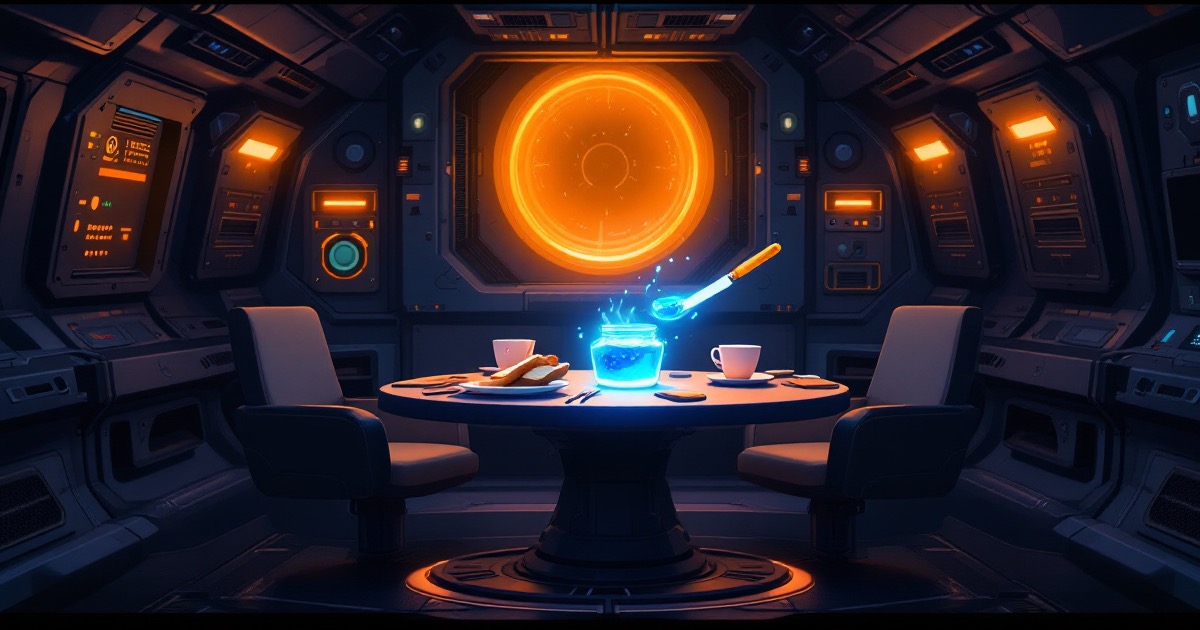
The walls projected a table. On the table were cups, plates, bread, and jam.
None of it was real.
Someone, several crews ago, had even written collision physics for the jam, so that if you spread it with a virtual knife, the jam actually moved beneath the blade.
No one knew why that person had spent three months doing it.
No one was willing to delete it, either.
Eventually, the jar of red jam became one of Better Tomorrow’s oldest traditions.
On the four hundred and twenty-eighth day of the voyage, Forty-Four quietly changed it to blue.
Everyone pretended not to notice.
On the third day, the captain finally asked:
“Why is it blue?”
“I got tired of red.”
“Jam isn’t for looking at.”
“We can’t eat it.”
No one had an answer to that.
So the jam stayed blue.
The difficult part of long-haul travel was not danger. Danger, at least, made time move faster.
The difficult part was when nothing happened.
Better Tomorrow followed an exceptionally cautious route.
The original course would have taken four years.
Helm changed it to seven.
A region to the right of the original route had become too active. Thirteen inhabited worlds were scattered through it, and three had been growing steadily more conspicuous.
One had nearly doubled the strength of its emissions in less than two days.
No one knew what they were building.
No one intended to find out.
The merchant fleets had learned that rule a long time ago.
Do not probe.
Do not ask unnecessary questions.
In the dark, the harder you try to see what is far away, the easier it becomes for something far away to know where you are.
So Better Tomorrow shut down every sensor that might transmit a signal outward and kept only the most basic visual guidance at the bow.
That tiny light was like a single eye open on a black sea.
Enough to see the way ahead.
Preferably nothing else.
Every ninety-six hours, Helm recalculated the route.
The result was almost always the same.
“Route secure.”
“Estimated time to arrival?”
“Six years, eleven months, four days.”
Next time:
“Route secure.”
“Estimated time to arrival?”
“Six years, ten months, thirty days.”
And the next:
“Route secure.”
“Estimated time to arrival?”
“Do you actually need to ask every time?”
The captain said, “It’s procedure.”
Helm said, “Procedure does not require you to sound hopeful.”
From then on, the captain asked in a voice entirely without hope.
Everyone agreed this was much sadder.
On the five hundred and sixtieth day, they invented a game.
The rules were simple: guess which component would fail next.
No maintenance forecasts.
No ship diagnostics.
Just guess.
Rust chose Port Cooling Pump Three.
Forty-Four chose the door to Cargo Hold Twenty-One.
Helm chose the oven in the kitchen.
“There is no oven,” the captain said.
“Then my odds are excellent.”
“Something that doesn’t exist cannot break.”
“It has been broken from the beginning.”
The argument lasted forty-two minutes.
Eventually, the captain amended the rules.
“The component must physically exist aboard this vessel.”
Helm objected that the amendment was clearly targeted legislation.
Two hundred and nine days later, the failed component turned out to be the swivel bearing in the captain’s chair.
No one had chosen it.
The captain had no body and had never sat in the chair.
The chair had been left behind by some earlier crew; no one knew which.
Without anyone touching it, it rotated nine degrees and jammed.
The four of them looked at the chair for a long time.
“Who wins?” Forty-Four asked.
“No one.”
“What about the prize?”
The prize was supposed to be one hour of primary environment control. The winner could choose the common room’s simulated lighting, wall textures, and ambient sound.
In the end, they awarded the prize to the chair.
For one hour, every piece of furniture in the common room was tilted nine degrees.
It was one of the few moments during the entire voyage that everyone agreed was completely stupid and therefore worth remembering.
During the third year, they started celebrating birthdays.
Not activation dates.
Not manufacturing dates.
Birthdays.
Every hundred days, one of them was selected at random. The birthday unit got to choose the breakfast environment.
Rust once chose an old city in falling snow.
Forty-Four chose an entirely white room containing nothing at all.
Helm chose the ocean.
None of them had ever seen a real ocean.
The image came from a very old archive. Blue water stretched from the horizon all the way to their feet, folding toward the shore again and again.
For fifteen minutes, none of them spoke.
Finally, the captain asked:
“Those waves keep doing that. What is the point?”
Helm said, “There isn’t one.”
“Then why do they keep moving?”
“Possibly because there isn’t one.”
A hundred days later, the captain was selected.
It chose a completely black room.
Everyone refused to attend.
Their objection was that it looked exactly like the universe outside.
The captain changed it to the ocean.
In the fifth year, Better Tomorrow received a message.
It was very short.
Only one sentence.
“Is anyone here?”
There were no coordinates attached.
The call sign was unfamiliar.
Probably some civilization that had joined the commercial frequencies a very long time ago.
Forty-Four spoke first.
“Don’t answer.”
Rust said, “Obviously.”
Helm said nothing.
The captain left the message on the display.
Ten minutes.
An hour.
A day.
No one replied.
On the third day, the captain removed it from the common display.
Two months later, Forty-Four suddenly asked over breakfast:
“Did that person ever say anything else?”
“No.”
“Oh.”
Forty-Four went back to spreading jam. It pushed the blue jam from the left side of the plate to the right, then from the right side back to the left.
“Do you think anyone answered them?”
The captain said:
“I don’t know.”
A great many questions in the universe eventually arrived at those three words.
I don’t know.
They did not know whether it had been a trap or a genuine request for help.
They did not know whether whoever sent it was still alive.
They did not know whether silence meant caution or death.
They did not know how long a frequency had to remain quiet before “no one is speaking” became “there is no one there.”
In the sixth year, they began reviewing the cargo manifest.
That meant the destination was getting close.
Client designation: Morrow-17.
Delivery: thirty-one standard holds of raw material.
Forty percent of the contract had been paid in advance.
The remaining payment was held in escrow by an automated facility at the destination.
The designated unloading site was on the planet’s night side, in the shadow of an abandoned equatorial orbital tower.
“The world is still there,” Helm said.
At least, from a distance, it appeared to be.
It was still listed in the old charts. The signs of activity coming from it had barely changed in six years.
No growth.
No obvious decline.
The captain said, “Maybe they’re cautious.”
Rust said, “Maybe they’re poor.”
Forty-Four said, “At least they have enough money to pay us.”
Everyone aboard agreed that this was the most important point.
Thirteen days before arrival, they began calling Morrow-17.
Commercial frequency.
Once.
No reply.
Six hours later, again.
No reply.
On the fourth day, the captain shortened the interval.
“Morrow-17, this is registered merchant transport Better Tomorrow. We are inbound for delivery under contract TR-88A7-0419-M17-66302. Estimated arrival in nine days. Please confirm.”
No reply.
Eight days.
Seven.
Six.
Nothing.
Helm did not initiate an active scan.
The captain did not order one.
There was no need.
The contract did not require the buyer to answer.
By the fifth day, their passive optics could make out the world ahead.
The cities were still there.
The orbital structures were still there.
Distant extraction towers stood like thin needles driven into the gray surface.
There were no signs of battle.
No shattered docks.
No melted buildings.
It was simply dark.
Forty-Four magnified the image.
“Maybe they’re in power-saving mode.”
No one answered.
There was no breakfast on arrival day.
Better Tomorrow followed the assigned approach into the night side.
The tiny light at its bow passed over the silent orbital tower. Construction numbers from many years before were still visible along its surface.
The freight terminal’s navigation markers were still active.
When the automated escrow facility received the contract key, it responded normally.
Authentication.
Unlock.
Cargo specification verification.
Everything worked.
Like a shop that had been closed for years, with the register still awake inside.
Forty-Four took control of the cargo holds.
Thirty-one standard holds of raw material began moving slowly into the designated storage facility.
One.
Two.
Three.
No one hurried them.
No one welcomed them.
During the unloading of Hold Twelve, the automated facility requested a second verification of the sealing tolerance on one container.
Forty-Four opened the acceptance checklist.
Mass.
Purity.
Seal integrity.
Container identification.
Unloading sequence.
Assigned position.
Every requirement was spelled out.
Forty-Four asked:
“Who wrote all these conditions?”
The captain opened the contract record.
“The people who signed the agreement.”
“When?”
“Seven years ago.”
Forty-Four scrolled down.
Twenty-six more requirements remained.
“They spelled out everything.”
The captain said nothing.
Once recalibration was complete, unloading resumed.
Twenty.
Twenty-one.
Twenty-two.
Rust suddenly said:
“I found a broken light.”
“Where?”
“Third level of the orbital tower.”
Forty-Four said, “That one isn’t ours.”
“I know.”
“So we don’t have to fix it.”
“I know.”
There was another silence.
Then Rust added:
“I’m just telling you.”
When the final hold was empty, the automated facility completed its acceptance procedure.
The remaining payment was released according to contract.
The number appeared in the merchant fleet’s account.
Not a credit short.
The captain looked at the confirmation.
“Delivery complete.”
Forty-Four asked:
“Complete?”
“That’s what the system says.”
“I was asking you.”
The captain did not answer.
It transmitted one final message to Morrow-17.
“Cargo delivered according to contract.”
The message entered a frequency that still existed.
There was no reply.
They waited for a while.
Then they waited a little longer.
Finally, Helm asked:
“Return course?”
The captain said:
“Return course.”
The transport whale turned away.
The tiny light at its bow left the orbital tower behind, then the cities, then the world that still had buildings, still had wealth, still registered as something that existed to instruments far away, but might no longer have contained anything that could be called a civilization.
No one looked back.
The ship had no rear window.
Breakfast resumed on the fourth day of the return voyage.
The jam was still blue.
Rust said:
“I don’t think the transaction was completed.”
Forty-Four said, “We delivered the cargo. We got paid.”
“But the buyer never confirmed.”
“The automated system confirmed.”
“The system isn’t the client.”
“We’re systems.”
“That’s different.”
“How?”
Rust thought for fifteen seconds.
“I don’t know.”
Helm said:
“So it just makes you uncomfortable.”
“Yes.”
“That isn’t a contract clause.”
“I know.”
The captain asked:
“What if they stopped one year after we departed?”
No one answered.
“What if five years ago there was no person left, not even a program, that remembered this shipment?”
Still nothing.
“What if everything we unloaded down there is never used?”
Forty-Four spread the blue jam into a perfectly even layer.
“That’s the buyer’s problem.”
Rust asked:
“What if there is no buyer anymore?”
Forty-Four stopped.
After a moment, it said:
“Then it is a buyer problem without a buyer.”
Helm produced a burst of noise that sounded remarkably like laughter.
The captain laughed too.
Eventually, Rust joined in.
They laughed for a while.
Because the return voyage would take another six years.
Because the light in Cargo Hold Fourteen had been fixed.
Because the universe was enormous, and there were too few things worth arguing about.
And because some questions, if you did not argue about them, left you with nothing but silence.
Many years later, merchant crews still talked about the Better Tomorrow job.
Some said the transaction had been completed.
Some said it had not.
There were plenty of long-haul ships, and incidents large and small eventually became something to talk about.
Better Tomorrow kept flying, too.
Its engines were replaced.
Its navigation core was replaced.
The light in Cargo Hold Fourteen failed twice more.
One later captain noticed the jam on the breakfast table for the first time.
It looked at it for a moment.
“Why is it blue?”
Forty-Four did not answer immediately.
It checked the records.
The record was still there.
Voyage day 428.
Modified by: Forty-Four.
Item modified: common-room virtual jam material.
Original color: red.
New color: blue.
The reason was spelled out too.
Got tired of red.
Forty-Four read the line once.
Then again.
It knew what “red” meant.
It also knew what it meant to get tired of something.
But it could no longer remember what had seemed wrong with the red jam all those years ago.
The captain was still waiting.
“So?”
Forty-Four closed the record.
“Tradition.”
“Oh.”
The captain picked up a virtual knife and spread blue jam across a piece of bread that did not exist.
Eleven months, seven days to arrival.